Skip to content

Cart

Your cart is empty

Article: 10 Celebrities That Are Known for Their Affinity for Puzzle-Solving

10 Celebrities That Are Known for Their Affinity for Puzzle-Solving

Think puzzles are just a casual pastime? Think again! From Hollywood stars to world-renowned musicians, many celebrities turn to puzzle-solving as a way to relax, sharpen their minds, and spark creativity. In this article, we highlight 10 famous personalities who share a love for jigsaws, crosswords, and brain teasers—and show how puzzles have become a surprising part of their lifestyle.

10-Celebrities-That-Are-Known-for-Their-Affinity-for-Puzzle-Solving Toys Quiz

It’s easy to let your mind wander when thinking about what various celebrities do to unwind. Sure, there are likely some yachts and private jets involved in the process, simply because they have the means to afford it, but behind closed doors, they’re very much ordinary people with ordinary hobbies. And, as you may have guessed, some have a knack for solving puzzles!


Do you know some of the celebrities that we’re about to talk about? Have they influenced your life in some way? Here are their stories.


1. Patrick Stewart


Star Trek’s most beloved captain is very much an intellectual, and so is the person playing him. In his spare time, he is known for being drawn to puzzles as it helps stimulate and challenge his brain. He has a penchant for solving jigsaw puzzles in particular.


As a matter of fact, he has publicly expressed his preference for sticking to 1000-piece puzzles only. However, he did not express a thematic preference. In his world, solving puzzles helps him relax. After finishing a puzzle, he likes to frame it and showcase it.


2. Bill Gates


Turns out the renowned ex-CEO of Microsoft has an affinity for solving puzzles as well. Although he is one of the richest people on Earth, he gravitates towards this type of hobby that doesn’t require a massive capital to get things off the ground. To him, solving puzzles is the kind of joy that virtually no other activity can replicate.


He is lucky to have a wife who shares the same passion. As they’re both competitive in nature, they like to get identical puzzles and race against one another to the finish line. It goes without saying that puzzles are a must-include item for the family holidays as well.


3. Hugh Jackman


Who would have thought that the majestic Wolverine is secretly a puzzle fanatic? As masculine as his appearance might be, the person behind the character has a softer side that’s not as well known. Unless, of course, you like to frequent his social media posts where he occasionally posts about his hobby.


Call it a publicity stunt or simply the heat of the moment, one time he decided to tear apart a puzzle that took him several months to assemble. In other words, the actor decided to seal its fate in a true Wolverine fashion!


4. Ellen Degeneres


Ellen may no longer be doing her iconic talk show, and since she hasn’t announced any plans on doing anything similar in the near future, she tends to have a lot of free time on her hands. Can you guess how she likes to spend her days?


These days, it’s not under the spotlight, but rather in her cosy home solving puzzles. In fact, she is quite hardcore about it, often demonstrating the willingness to challenge herself with a more difficult puzzle than what’s intended for the more casual masses. 


5. Nick Offerman


The best couples are the ones that share similar interests. As it so happens, Nick and his partner Megan Mullally both have a fiery passion for puzzle-solving!


They’re quite vocal about it on social media too, often posting about how this is the way they like to spend their time together.


6. Kylie Jenner


Kylie Jenner is more than a millionaire - her net worth exceeds 1 billion USD. And yet, she’s just as prone to boredom as any other human being with much less to their name. Several sources suggest that the make-up icon took her first steps into puzzle-solving as her motherhood had begun.


She doubled down on it when the world was in a Covid-induced lockdown and it became one of her main mechanisms to cope with the prevailing situation. Given how many people took a much more maladaptive route, filling her days with puzzle-solving goodness stands out as something commendable indeed.


7. Ronnie Wood


Rock and roll in the public eye, puzzles when not on the center stage. That’s Ronnie Wood, the iconic guitarist of the Rolling Stones. His public persona might be hardened and rough around the edges, but as many other rock stars of his kind, he does have a softer side that his loved ones know full and well.


According to his own words, his love for puzzle-solving helped him overcome his drinking problem - how about that! It turns out that puzzles are not only good for the brain, but for the soul and body as well, and Ronnie’s story is a testament to that.


8. Tom Hanks


Yet another one of the world’s all-time top actors who can’t resist a good old puzzle. In Tom’s case, this would be crossword puzzles, in particular. These tend to be a go-to for the linguistically inclined, which is something we can surely say about Tom Hanks.


His case once again highlights that puzzles of various sorts help keep one’s mind sharp, as he himself has said in interviews. He also likes how solving them helps him pass the time during breaks on film sets.


9. Kate Middleton


Kate Middleton is one of the UK’s most prominent public figures. Known for her intellectual demeanor, it’s no secret that brain-teasing activities is something that occupies her private life as well.


Sudoku and crossword puzzles are what happens to be her cup of tea. In her view, these not only help keep her mind sharp, but also act as a force that balances her official duties and family life.


10. Emma Watson


The iconic Harry Potter star places education and self-development right around the top of her priority list. Of course, that includes keeping her mind sharp as well, and being good at solving puzzles is right up her alley.


For her, the experience is as relaxing as it gets and it also helps her take her mind away from the spotlight. She has also encouraged her fans to try their hand at one of these on several occasions.


Conclusion


Although each and every celebrity on the list has unique personal reasons for loving puzzles, it mostly boils down to stimulating one’s mind, sharpening one’s memory and thinking, entertainment away from the pressures of public life, as well as a sense of accomplishment.


Since celebrities tend to be the role models of many, they serve as a remarkable influential force for promoting the brain-teasing hobby we all know and love. Has a celebrity influenced your tastes and hobbies as well? Let us know.

Share
Subscribe to Our Newsletter

Toys Quiz is a creative lifestyle company dedicated to designing and developing 3D puzzles, toys, and wooden handicrafts. Subscribe to learn more.
Leave a comment

This site is protected by hCaptcha and the hCaptcha Privacy Policy and Terms of Service apply.

All comments are moderated before being published.

Read more

7-Things-to-Consider-Before-Buying-Your-First-3D-Puzzle Toys Quiz

7 Things to Consider Before Buying Your First 3D Puzzle

To many, 3D puzzles are a momentary escape from reality, a therapeutic retreat from the hectic world of today. Couple that with how they are bound to hone your cognitive skills, and you have plenty of reasons to try them out yourself. And, once you’re done assembling your very first 3D structure, a magnificent wonder awaits, the kind you can easily put on display and amaze your friends with. Exciting as the idea may be, it’s recommended to step back for a bit and think things through. After all, this is going to be your first experience with a 3D puzzle, so it makes sense to make it an enjoyable one. For instance, you shouldn’t go for the hardest 3D puzzles straight off the bat - you’ll give up prematurely, which would be a shame. Now let’s take a look at what else goes into the equation of picking a suitable one. 1. Design and theme Do you have a thing for animals? Are gigantic buildings and robotic structures more to your liking? Look for a theme that resonates with what you’re passionate about. It may sound trivial, but in reality, it shares a deep link with your interests. In other words, you’ll be much more motivated to get started and complete it if it presses the right buttons of your soul. So if we were to pretend this is the only factor that comes into play when choosing a 3D puzzle, pick something you’d love to put on display after finishing it. 2. Assembly method Did you know that there are certain 3D puzzles that require special tools to assemble? The good news is that you’ll often receive these tools as part of the bundle, but some may prefer one method of assembly over the other. Even if you’re adamant on using your hands exclusively, some mechanisms rely on the snap-in method, others you’ll have to twist or slide into place, etc. There are even some 3D puzzles that feature a magnet mechanism. Take your pick! 3. Time commitment How much time do you have on your hands? Can you afford to spend an entire afternoon solving a puzzle or would you rather pick up something to fiddle with while watching a movie? Different 3D puzzles require a different amount of time commitment, and this is closely tied to the concept of varying difficulty levels we’ve discussed in one of our previous posts. In terms of time commitment, this translates as follows: Easy 3D puzzles: 1-3 hours to solve Medium 3D puzzles: 5-10 hours to solve Hard 3D puzzles: 20+ hours to solve Mind that one difficulty group isn’t necessarily better than the others; it all comes down to your unique tastes and preferences. As a beginner, you should try your hand at one of the easier puzzles before upping the difficulty level. 4. Material type 3D puzzles come in a wide array of materials, each with their own distinct texture and feel. Beyond mere aesthetics, this also affects their durability aspect - for instance, metal 3D puzzles tend to be tougher than their wooden counterparts. Technically, there is even such a thing as 3D puzzles made out of cardboard or foam board; these are a great option for small kids, since you won’t have to worry about them swallowing something potentially dangerous. If you have a tight grip (or are prone to outbursts of rage when you just can’t figure things out), go with metal 3D puzzles. If aesthetics are a priority, wooden 3D puzzles are some of the most visually appealing options. This is by no means a rule, however - more of a guideline. To summarize some of the popular 3D puzzle material types: Wood Metal Plastic Foam 5. Skill level You should also choose your first 3D puzzle based on your existing level of experience and appetite for challenging yourself. If you’ve never even held one of these in your hands, it’s probably best to start with a beginner-level puzzle. It should be composed of no more than 100 individual pieces, otherwise you’ll get overwhelmed. After you’ve become comfortable with solving some of these, it’s time to move on to medium difficulty. These puzzles kick things up a notch by introducing intricate shapes and moving parts. Finally, when you’re ready for the ultimate challenge, give the hardest 3D puzzles a try, the kind that play around with the concept of interlocking systems, gears, mechanical structures and more. The idea is to find a fine line between challenge and fun - misjudge your own capabilities, and you could end up either frustrated or bored. 6. Price range While the price tag should never be the only consideration, it certainly is something to bear in mind. So with that in mind, what’s a good price you should be paying? The answer depends on the 3D puzzle material quality and several other factors. You should be asking yourself questions such as: Is it built to last? Is it from a reputable brand? Are there multiple pieces involved? Does it have special features like lights and moving parts? You should factor all of this in to determine if the 3D puzzle’s price tag is justified. Generally speaking, reputable brands are known for precision engineering and making sure to use only high-quality materials that won’t bend or break as easily. They’ll also go out of their way to include helpful instructions so you’ll have an easier time assembling it. Speaking of which… 7. Instruction clarity Having clear instructions at hand contributes to a much more fulfilling experience overall. However, it’s crucial for the manual to be easy-to-read; nowadays, simply having it is no longer enough. At the end of the day, having an illustrated guide is much more helpful than having to stare at an endless wall of text. In addition, it certainly helps if individual pieces are numbered and the instructions do a good job at explaining their functionality. As you probably know already, solving 3D puzzles requires a sequential approach, and that’s what numbers are for. And, if there is some form of video materials accompanying the written instructions, even better (although certainly not a must). Conclusion From budget and all the way to skill level, there are many things that go into picking a 3D puzzle. But if we were to condense it down to a single thing, it’s simply what captures your attention the most. The next important aspect would be nailing the right level of challenge; something that doesn’t bore or frustrate you. Armed with what you now know, it’s time to hunt down that perfect 3D puzzle!

Read more
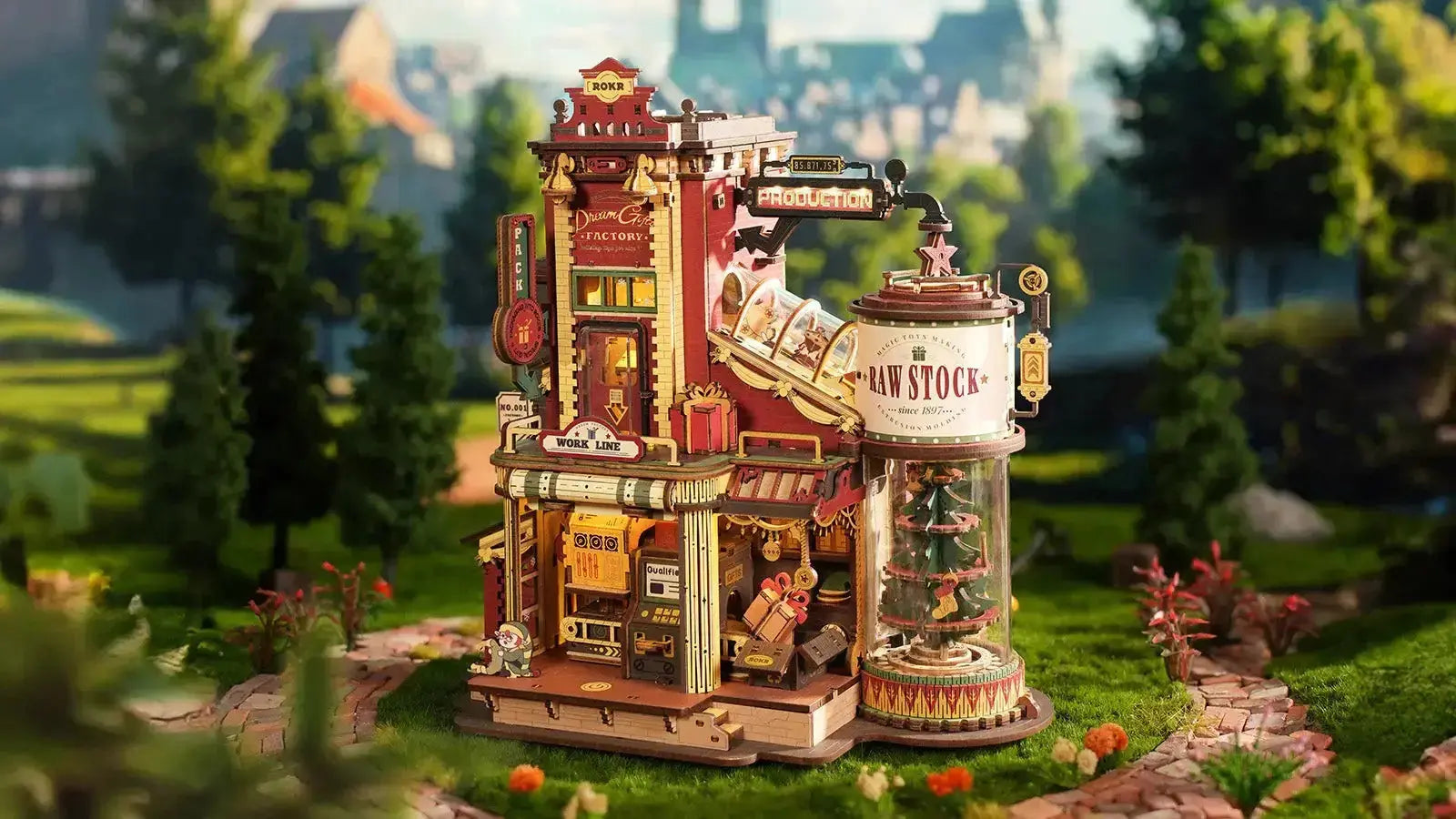
A-New-Building-Fun-Christmas-Dream-Gift-Factory-Now-Available Toys Quiz

A New Building Fun, Christmas Dream Gift Factory Now Available!

If you've been eyeing those tiny glowing bookshelf worlds on social media, this is your rabbit hole. We broke down 5 of the best Japanese-themed Book Nook kits — from a Sakura tram scene with 340 pieces to a music box that actually plays — so you can find the one worth your weekend.

Read more

Explore Toys Quiz Product Categories

Expand your hobby with our most creative DIY and craft kits. The immersive building experience offers a whole new way to relax and unwind.